

Article
Gluesync 2.3.1: write policies, safe snapshot resume, and Greenplum, Vertica and SAP ASE agents
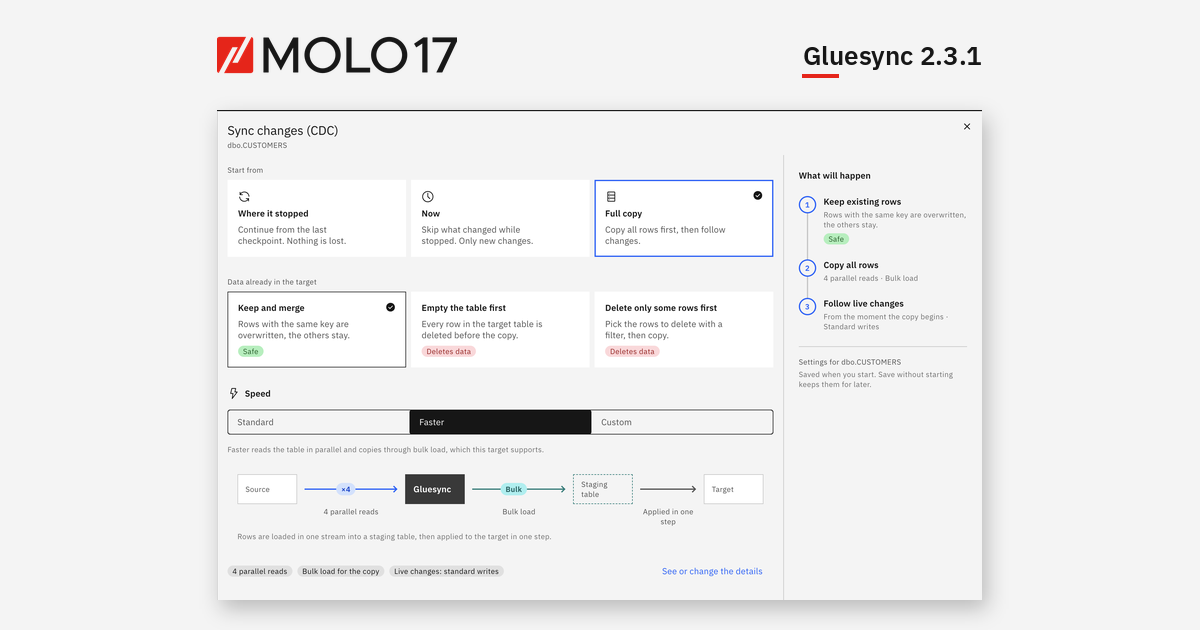
Gluesync 2.3.1: write changed columns only, resume snapshots safely, and replicate with new Greenplum, Vertica source and SAP ASE log reader agents.
Gluesync 2.3.1 was released on 25 October 2026. Each entity now picks a write policy, so a CDC update writes only the columns that changed. The new start dialog shows where every entity resumes before you press start. Three new agents join the catalog: a Greenplum target, a Vertica source, and an SAP ASE (Sybase) log reader.
Two weeks after 2.3.0 put AI on your own keys and the write path under your control, 2.3.1 continues in the same direction: fewer wasted writes, snapshots that pick up where they stopped, and more databases on both ends of a pipeline. Every point below is checked against the official release notes.
Write policies: only the columns that actually changed
Each entity chooses its own write policy, so the target receives exactly the work the transaction did:
- Changed Columns Only writes just the columns the transaction changed
- Skip Unchanged Rows drops an update whose non-key columns did not change
- Missing source values: for a value the source does not have (a SQL
NULLor a missing document field), writeNULL, leave the column out, or let the target apply its default
When an update does not find its row on a document-store, key-value or wide-column target, Gluesync creates the row with its unchanged fields too, so the document lands complete. Targets that always write a whole row, such as BigQuery, Cosmos DB and Microsoft Fabric Open Mirroring, and entities that write in bulk refuse the policies when you save, so the setting you choose is always the setting that runs.
Start where you left off, and see it before you click
The new start dialog shows where each entity resumes from before you start it. From the same dialog you pick snapshot and CDC options, set the snapshot speed, and change several entities at once, on desktop or on a phone.
An interrupted snapshot continues only when it was read in key order, so every row reaches the target. When the read order makes continuing unsafe, the snapshot starts over and Gluesync tells you why. Core Hub now reports the resume position of every entity of a pipeline, and a continued snapshot keeps the time of its first start. See Snapshot tasks and the Entity Play/Pause panel.
Three new agents: Greenplum, Vertica and SAP ASE
Greenplum target
The Greenplum target agent writes snapshots and CDC into Greenplum Database 6 and 7. Its bulk path loads through COPY on the coordinator or through an embedded gpfdist server that every segment reads in parallel. Tables the agent creates get a distribution policy and, optionally, append-optimized storage with compression.
Vertica source
The Vertica source captures changes by comparing epochs. The snapshot reads every table AT EPOCH of one pinned epoch, in parallel hash buckets, and CDC starts from that same epoch, so the handover from snapshot to CDC is exact. The agent creates no triggers, no shadow tables and no objects of its own, and only runs SELECT statements. The same agent already writes to Vertica as a target.
SAP ASE (Sybase) log reader
The Sybase ASE log reader (agent tag sybase-logreader) reads CDC from the ASE transaction log through the server's own Replication Agent (RepAgent) thread. Nothing is installed on the ASE host and no triggers or shadow tables are created. It delivers before images for updates and deletes, captures truncates, and adds no load inside the writing application's transactions. The triggers agent (sybase) stays available for databases already replicated by SAP Replication Server.
Faster snapshots into SQL Server
Snapshot pages into SQL Server now stream through one bulk copy kept open across pages, instead of one copy per page. Wide tables and high-latency links benefit most. The MS SQL Server CDC and Change Tracking agents both gain it as targets, with new directCopyChunkSizeMb, directCopyChunkSeconds and directCopyChunkIdleSeconds settings.
Query Studio in your pocket
Query Studio on Gluesync Mobile is rebuilt for the phone around cards and bottom sheets:
- A query editor with SQL highlighting, quick-action chips, and a connection picker that remembers your recent connections
- Results in a mobile table, with a detail sheet for each row
- Query history and saved queries one tap away, with the AI helper laid out for the small screen
Also in 2.3.1
- Metrics: Total Data Transferred counts the actual payload, and a new Snapshot Data Transferred metric is reported per source and target. The entity detail shows data transferred over all its targets
- Resilient loads: bulk snapshot loads restart from their last checkpoint when a flush fails, CDC polls again at once after a full page, and stopping an entity under heavy load cancels its running operations
- MCP:
create_entityanddraft_entityon an existing entity keep its stored source settings, and change the polling interval only whenpolling_interval_msis given - Security: deny sign-in by OIDC group, so users in a denied group stay out whatever their other groups grant
- UI: user, group and access settings under Settings → Users & access groups, a Remote support card under Settings → Support, and clearer update errors reachable from the top bar
- Agents: payload-sized write chunks on Cassandra, ScyllaDB, Google Pub/Sub, Azure Cosmos DB, Apache Kafka, Aerospike and Couchbase; faster CDC reads on Informix; typed array columns on CockroachDB and YugabyteDB; date and
timetzfixes on PostgreSQL and YugabyteDB
Every change, agent by agent, is in the Gluesync 2.3.1.0 release notes. Ready to upgrade? Get the latest version and put write policies, safe resume and the new agents to work on your pipelines.