01 / Costly pipelines
ETL just to ask a question
Teams stand up warehouses and extraction jobs so BI and DBAs can join data that already lives behind Gluesync agents.

Gluesync Module · Federated SQL queries
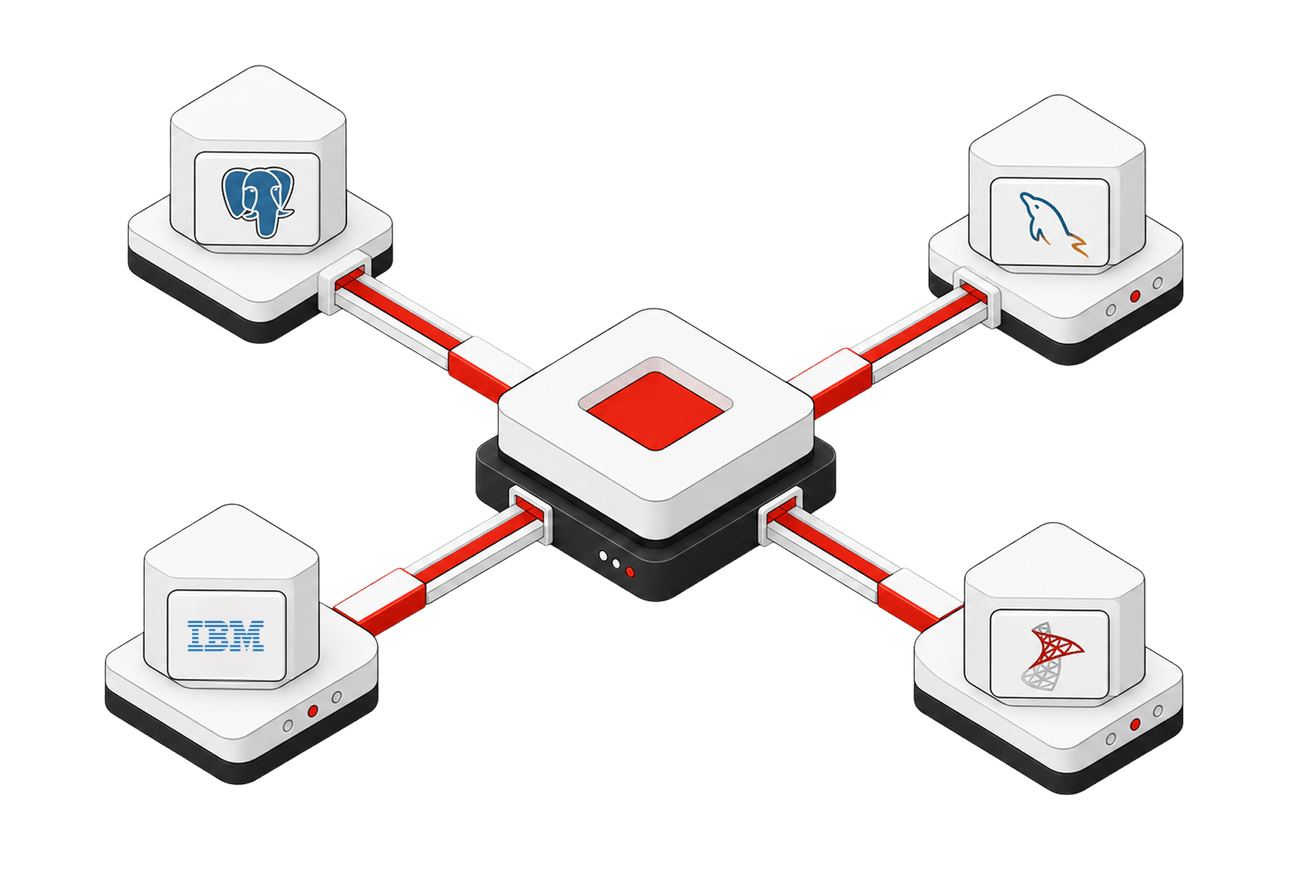
A secure federated SQL gateway on Core Hub. Run cross-database JOINs across isolated agents with zero raw data movement.
Why Query Forge
01 / Costly pipelines
Teams stand up warehouses and extraction jobs so BI and DBAs can join data that already lives behind Gluesync agents.
02 / Manual stitching
Without federation, analysts run separate queries in different tools and reconcile results in spreadsheets — slow and error-prone.
03 / The platform outcome
Query Forge turns Core Hub into a JDBC gateway so one SQL statement can join remote schemas without copying raw datasets.
Capabilities
Built on Query Studio infrastructure, Query Forge exposes each SQL-capable agent as a schema and plans joins centrally with intelligent pushdown.
Federated architecture
Instead of new data movement pipelines, Core Hub receives the SQL statement, pushes projections and filters to remote agents, then evaluates joins with Apache Calcite.
SELECT c.name, SUM(o.amount)FROM pg.sales.orders oJOIN ora.crm.customers c ON c.id = o.customer_idWHERE o.status = 'paid' AND c.region = 'EMEA'GROUP BY c.name2.4M rows stay at the source18,240 sent
Runs on PostgreSQLWHERE status = 'paid'
310K rows stay at the source4,115 sent
Runs on OracleWHERE region = 'EMEA'
Query across relational, legacy, NoSQL and data-lake environments from a single development tool or BI connection. Gluesync resolves schemas and returns results transparently.
Standard connectivity
A branded JDBC endpoint (jdbc:gluesync://host:port) makes Core Hub feel like a single SQL system to external clients.
SQL clients
JDBC gateway
One connection string. The caller's token. Read-only pushdown to each agent.Agents
One connection string. Many agents. Warehouse-style querying flexibility without storage overhead or continuous extraction latency.
Enterprise safety
Every federated query runs under the caller’s identity through the read-only execution path, with permissions scoped to pipelines and agents.
 Settings · Query data access
Viewers can never unmask, even with a grant.
SQL-callable AI · Available in Gluesync 2.3
Query gluesync.ai from your JDBC client. The Hub uses your configured model and governed MCP tools, then returns one structured row you can inspect, store, or continue with a conversation ID.
Available in Gluesync 2.3 · Read-only tool path
SELECT answer, proposed_sql,
       citations, conversation_id
FROM gluesync.ai
WHERE question = 'who made you';proposed_sql is returned for review. It is never executed automatically.
gluesync.ai appears through Query Forge alongside the schemas you already query, using the same authenticated session.
Receive answer, proposed_sql, citations, and conversation_id as columns—not an opaque chat response.
The request uses the Core Hub LLM provider vault. MCP discovery and invocation remain bound to the JDBC caller’s RBAC.
The answer may include SQL for a next step, but Gluesync never runs proposed_sql automatically. You decide what executes.
Explore the platform
Query Forge extends Query Studio into a federated gateway. Explore the workbench, Knowledge querying, or the full Gluesync platform.
Join Parquet, CSV and JSON datasets in your lake with live databases in one federated query.
Explore Lake queries →Embedded SQL workbench in the Control Plane for schema browsing and live validation.
Explore Query Studio →Chronos schedules, chained workflows, webhooks, and Core Hub event triggers.
Explore Schedules and events →Real-time CDC plus federated querying under one Core Hub operational interface.
Explore Gluesync →Resources
Technical guides, API reference, deployment tutorials.
Read documentation ↗What we're building next. Submit feature requests.
View roadmap ↗Access technical support and operational assistance.
Get support →Real-time platform availability and incident history.
Check status ↗Request a free trial or talk with the MOLO17 team about deploying Query Forge on your Core Hub.